Reviewed and approved between January and March 2026
Published: April 7, 2026
Cocam Cia de Café Solúvel e Derivados conducts its operations based on unwavering principles of integrity, honesty, and responsibility. In 2023, this commitment was formalized through the implementation of the Integrity Program, structured around the six pillars recommended by Controladoria-Geral da União (CGU).
This version of the Program results from the review conducted between January and March 2026, with validity through December 2028. The revision incorporates regulatory developments and lessons learned during the 2023–2025 cycle.
| Period | Milestone |
| 2023 | Implementation of the Integrity Program. |
| 2024 | Document review with mandatory training. |
| 2025 | Consolidation of integrity culture. |
| 2026–2028 | Current cycle. |
For the purposes of this Program, the following definitions apply:
|
Integrity The quality of being honest and ethical. At Cocam, it involves adherence to high moral standards, transparency in actions, and a culture that values honesty at all hierarchical levels. |
|
Compliance Adherence to laws, regulations, and established standards, ensuring Cocam’s processes and policies align with applicable legislation and ethical principles. |
|
Compliance Culture An organizational environment that promotes voluntary adherence to rules and encourages ethical behavior as an intrinsic value. |
|
Stakeholder Any individual or group that affects or is affected by Cocam’s activities, including employees, suppliers, customers, communities, and regulators. |
|
Due Diligence A process of prior investigation and risk assessment before initiating or renewing business relationships, contracts, or partnerships. |
The Integrity Program is based on the following regulations, without prejudice to other applicable rules:
| Regulation | Description |
| Law No. 12,846/2013 (Anti-Corruption Law) | Establishes strict administrative and civil liability of legal entities for acts against public administration. |
| Decree No. 11,129/2022 | Regulates the Anti-Corruption Law and defines Integrity Program requirements. |
| Law No. 13,709/2018 (LGPD) | Governs personal data processing, requiring transparency, security, and accountability. |
| CGU Guidelines | Integrity Program guidance for private companies. |
| Local and Sectoral Rules | Labor, environmental, tax, and regulatory laws applicable to Cocam’s operations. |
For the 2026–2028 period, Cocam reaffirms the following fundamental commitments:
The "Tone at the Top" set by leadership is recognized as a critical element for the effectiveness of any Integrity Program. At Cocam, Senior Management:
Exemplary Leadership
Leads by example, demonstrating a visible commitment to the established ethical values and principles, and refusing any conduct that violates the Code of Ethics and Conduct, even when under commercial or performance-based pressure.
Adequate Resources
Allocates the human, financial, and technological resources necessary to effectively implement, operate, and maintain the Integrity Program throughout the 2026–2028 cycle.
Support and Involvement
Actively encourages all employees to comply with compliance policies and procedures, participating in training initiatives and communicating their adherence to the Program.
Periodic Evaluation
Analyzes, at least semi-annually, the Program’s performance indicators, reports received through the Whistleblower Channel, and internal and external audit results, deciding on any necessary measures.
Cocam’s Integrity Program is structured around the six pillars recommended by the Controladoria-Geral da União (CGU):
| Pillar | Description |
| 1. Commitment and Support from Senior Management | Setting the "tone at the top," allocating resources, and ensuring the visibility of leadership’s commitment. |
| 2. Unit Responsible for Implementation | An Integrity Committee with autonomy, independence, and a multidisciplinary structure. |
| 3. Profile Analysis and Risk Management | Continuous mapping, assessment, and mitigation of integrity and compliance risks. |
| 4. Structuring Rules and Instruments | Codes of conduct, policies, procedures, contracts, and control mechanisms. |
| 5. Continuous Monitoring of the Program | Performance indicators, audits, periodic reviews, and continuous improvement. |
| 6. Effective Communication with all Parties | Training, awareness campaigns, and a whistleblower channel. |
The Integrity Committee is the area responsible for the execution, decision-making, monitoring, and constant review of this Program, acting with autonomy and independence from other business units.
Composition
| Department | Representative |
| Legal | Marcos Aurelio de Paula |
| Quality Assurance | Roseani Caseri Pereira |
| Controller's Office | Fernando de Oliveira |
| Human Resources | Jose Domingos Cestari |
| Senior Management | Marcos Murari e Sidnei Beraldi |
Responsibilities
Contact: comitedeintegridade@cocam.com.br
The core documents that make up the Program's regulatory framework are subject to periodic review and are accessible to all everyone on the Cocam institutional website:
Code of Ethics and Conduct (POL-724-003)
Outlines the expected conduct for employees and stakeholders, establishing moral and ethical standards and reflecting organizational values. It covers relations with employees, customers, suppliers, government agencies, the community, and shareholders, requiring compliance with current regulations and international human rights standards.
Supplier Code of Conduct (POL-724-005)
Establishes clear guidelines for suppliers and service providers, covering legal compliance, internationally recognized standards, and ethical practices regarding labor, environment, safety, and anti-corruption.
Included Principles:
- Privacy and Data Protection
Regulates the processing of personal data for employees, customers, suppliers, and other data subjects, in compliance with the General Data Protection Law (LGPD - Law No. 13,709/2018).
- Conflict of Interest
Defines what constitutes a conflict of interest, the disclosure procedures, and applicable management measures, ensuring impartial decisions based on Cocam's best interests.
- Gifts, Presents, and Hospitality
Establishes limits and approval procedures for receiving and granting gifts, entertainment, and hospitality, preventing conduct that could be interpreted as bribery or undue advantage.
- Interaction with the Public Sector
Defines rules for relationships with public agents and agencies, including bidding processes, obtaining licenses, tax assessments, and legitimate lobbying activities.
- Third-Party Due Diligence
Regulates the prior investigation of suppliers, service providers, representatives, and business partners, classifying them by risk level and defining the necessary diligence for each case.
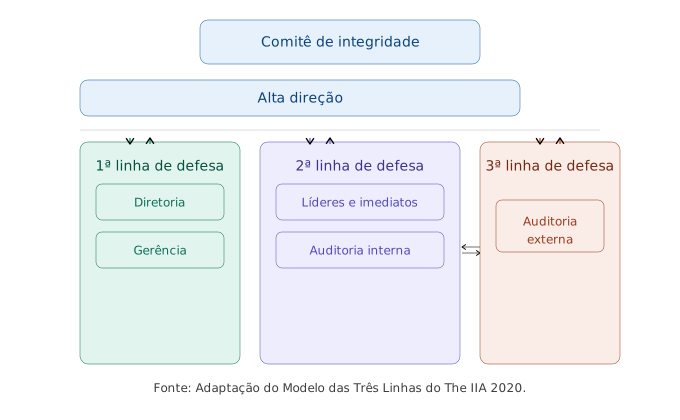
The three lines of defense model ensures that integrity risks are managed in a structured and complementary manner:
| Line of Defense | Actors and Responsibilities |
| 1st Line – Operational Management | Management and leadership (area representatives). They ensure integrity, leadership, and transparency in daily operations, implementing preventive controls and reporting deviations. |
| 2nd Line – Monitoring and Control | Leaders, supervisors, and Compliance/Legal and HR functions. They continuously monitor activities, offer specialized support, and challenge practices that may compromise integrity. |
| 3rd Line – Independent Audit | External Audit. Performs independent assessment and advisory regarding the achievement of the Program objectives, validating its effectiveness and issuing technical opinions to Senior Management. |
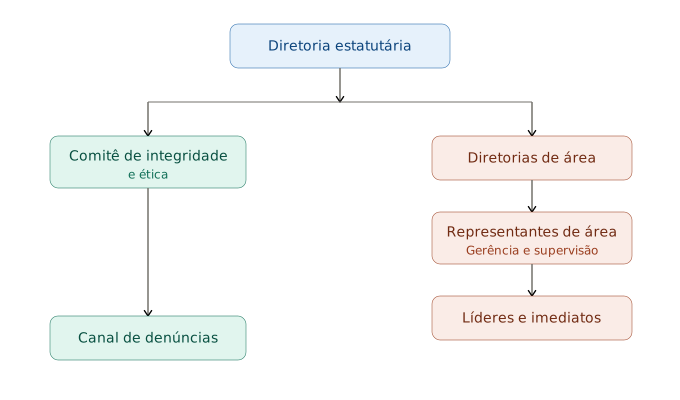
Cocam’s Whistleblower Channel is operated by a specialized and independent company, ensuring total autonomy from company management:
The Ethics Committee is the body responsible for analyzing, investigating, and deliberating on reports received, ensuring a fair and independent investigation of the facts.
The Integrity Program provides for proportionate and fair consequences for violations, considering the gravity of the infraction, recurrence, intent, and the offender's cooperation in investigations.
11.1 Violations by Employees
| Measure | Description |
| a. Graduation of Sanctions | Verbal warning, written warning, and suspension, according to the severity of the conduct. |
| b. Training Prerequisite | Completion of specific training as a condition for reintegration or continued employment. |
| c. Corrective Actions | Access restrictions, review of authority levels, and contract termination without cause. |
| d. Contract Termination | Dismissal for cause, reserved for cases of serious violation or recidivism. |
11.2 Violations by Third Parties (Suppliers and Service Providers)
| Measure | Description |
| a. Formal Warning | Formal notification with a deadline to present an appropriate action plan. |
| b. Review and Audit | Execution of a special audit of operations. |
| c. Temporary Suspension | Interruption of supply or services during the investigation. |
| d. Mandatory Training | Compulsory participation in a training program as a condition for continuity. |
| e. Contractual Fine | Application of financial penalties as provided for in the contract. |
| f. Contract Termination | Termination of the contract, with the possibility of legal action for losses and damages. |
| g. Debarment | Prohibition from participating in future selection processes of the Cocam. |
The dissemination of an integrity culture is promoted through continuous training and communication actions structured for the 2026–2028 cycle, starting from onboarding/hiring and including refresher training for all employees.
The Integrity Committee has defined the following priority actions for the 2026–2028 cycle:
| Action | Description and Goal |
| 1. Legislative Compliance | Maintain active monitoring of regulatory changes and ensure timely updates to processes and internal documents. |
| 2. Ethics & Compliance Training | Expand training coverage to reach 100% of employees annually. |
| 3. Investigations, Due Diligence & Audit | Improve internal investigation processes and expand due diligence to 100% of high-risk suppliers. |
| 4. Review of Contracts & Policies | Incorporate integrity and anti-corruption clauses into 100% of new contracts with suppliers and customers. |
| 5. Data Management & LGPD | Consolidate personal data protection practices, including specific training and review of data processing activities. |
Cocam’s organizational structure is formalized through the Organizational Chart (ORG-723-001), accessible via the Quality Management System. The Integrity Committee reports directly to Senior Management, ensuring autonomy and independence.
The continuous review of Guidelines, Policies, and Procedures is essential for the effectiveness of the Integrity Program. The Program will be reviewed:
| Version | Date and Scope |
| v. 1.0 | January 2023 – Program Implementation. |
| v. 2.0 | January 2024 – Document review and Whistleblower Channel. |
| v. 3.0 | Jan–Mar 2026 – Current review (Effective: 2026–2028). |
This Integrity Program is binding for all employees, administrators, interns, apprentices, third parties, and others acting on behalf of Cocam, regardless of location or hierarchy.
Questions regarding interpretation should be sent to: comitedeintegridade@cocam.com.br.
Non-compliance subjects the offender to the measures in the Consequence Rules (Section 11), without prejudice to civil, labor, and criminal liabilities.
Cocam Cia de Café Soluvel e Derivados
Canal de Denúncias: https://aloetica.com.br/cocam | comitedeintegridade@cocam.com.br | +55 11 3066-3260